Every result you'll find is likely a treatment facility trying to sell beds. I built and ran treatment programs across the US. I was a drug and alcohol counselor, and now I'm a sober companion. Here's when rehab is the right call, and when you're being sold something you may not need.
The question I get asked more than any other, usually by someone whose hands are shaking a little as they ask it, is this:
Do I need rehab or not? What are my options?
Sometimes it's about them. More often it's about a son, a husband, a sister.
If you search it, you'll get a confident answer within about four seconds. Before you trust it: almost every page on the first page of those results is published by a treatment center.
I don't only know that from working inside the industry, or from the digital marketing side of it. I went and checked, recently. Ten results. Every single one was a facility, or a directory that sells leads to facilities.
That second part deserves more attention than it gets. A directory selling leads is not placing you based on quality of care. It's routing your phone call to whoever paid the most for it that day. Which is, arguably, illegal. That's a whole other article, and it's one of the things about this industry that genuinely bothers me. If you want me to write it, reach out and tell me.
They all converge on the same framing too. A sober companion, they'll tell you, is what you use after rehab. It's aftercare. It's the step-down.
That's a fair description of one use case. It's also, conveniently, the version you'd expect from people with beds to fill.

Why I can answer this differently
I spent fifteen years inside that industry. I know its ins and outs. I know its dirty secrets, and arguably I could air its dirty laundry if I ever actively chose to.
But this isn't a grudge piece. It's an open, honest, informational one, so that you can make the best decision for you or for someone you love, given your actual circumstances.
I started as a drug and alcohol counselor, with my degree from Hazelden Betty Ford in Minnesota, and spent over five years in the clinical space: interventions, families, group therapy, individual counseling, all of it.
From there I became a Compliance Director, a Clinical Project Manager, a Quality Assurance Officer and an Executive Director, and I built treatment facilities of my own. CEO, Co-Founder, Chairman. All the titles you get told to go collect one by one, and I checked them off. Thirty-bed programs, sixty-bed programs, you name it. The programs ran the full range, detox through outpatient, the highest level of care, constantly monitored. I hired the doctors, the PAs, the nurses and the clinicians. I trained them so entire programs could exist. Those programs were state certified, nationally recognized, and running into the millions in profit.
I don't say any of that to brag, or to suggest I know it all. I'm telling you so you know who is writing this, and so you understand that I'm coming at it from a place most people in this space have never stood in.
I've also been through detox and outpatient myself
On the personal side of it, not just the professional one. So I know both halves of this. How those programs get built and run, and what it feels like to be the one sitting inside them.
And if I still haven't convinced you that I'm here to support, and that there's information in here that will actually be useful to you, I went back and got my MBA from Pepperdine on top of all that. The clinical side taught me what good care looks like. The business side taught me why a program behaves the way it does. You need both to see what I'm about to describe.
I'll say clearly what I always say: I'm not a doctor. I was responsible for oversight, and for partnering with medical staff on providing appropriate levels of care and services from an operations and compliance standpoint. Not for practicing medicine.
That said, I do know exactly how those buildings work, what they're good at, and where they lose people. And as you know, I work as a sober companion now, so there's no reason for me to pretend one option is always the answer. In fact it would be dangerous for me to offer my services to someone who needs real medical attention, and I am more than aware of that. I wouldn't take on anyone who needs a higher level of care.
Equally, you need this information so you understand that you may not always need a given level of care just because somebody is working hard to sell you on it. That's what this is all about. Let's get into it.
Every treatment center is a business
Every treatment facility's job is to sell you on the idea that you have to do treatment first. That doesn't make them wrong. It also doesn't make them right. Like almost everything else in life, it's a business, and a business requires customers. In this case the customer is you, or someone you love. The phrase used inside the industry is "heads in beds."
I'm not out to attack anyone and this isn't a conspiracy theory. Nobody is sitting in a back room plotting. There are just a lot of companies working in a field where the money is huge and the customers are scared, and that combination brings out the worst in some people. Greed has overwhelmed more executives and more programs than I'd care to list.
Even the purest hearts can get corrupted once real money is involved.
I've watched good people start out with good intentions and six beds, grow, and somewhere in that growth begin paying for clients' insurance premiums, covering their rent, putting them up in apartments. And in the worst cases I have seen, compensating people to relapse, so they would come back into treatment at a higher level of care.
That last one is almost too appalling to put in an article. It is also the sad, honest truth.
I've also seen genuinely excellent programs run by people who care enormously. Both things are true.
Here's something to understand about the business side behind all of this. Once I understood it, I couldn't stop seeing it. (And to be clear: this is not how I operate, and not how I ever supported any program operating. But it's another thing to watch for.)
The return on investment (ROI) is higher when a client comes back. Somebody who completes treatment, gets well, and never needs you again is worth one admission. Somebody who cycles through three or four times is worth three or four. Good programs treat that first outcome as the cost of doing business and trust that success brings referrals. For the ones that don't, the money quietly pushes the other way. I've watched clients be kept longer than they needed to be more than once, particularly when the insurance was good or the family was paying out of pocket.
The manipulation I've seen at the ugly end of this is worse than that. I have watched people be talked into refinancing their homes to fund a stay. That one still bothers me. So does most of what I'm writing here, and it's a big part of why I shifted into the work I do now. I'm a bigger advocate for patient knowledge and patient protection than I've ever been.
What "individualized care" usually means
Every facility you call will describe individualized treatment planning and one-to-one attention. Their admissions teams are trained to say it, and trained to explain why not coming could cost you your life.
Here is what I can tell you with something close to certainty, having toured, worked in, and seen behind the scenes of a great many programs across the US. With a handful of honorable exceptions, the operating goal is to hire the lowest-credentialed staff they can legally use, pay them as little as possible, and run the highest client-to-staff ratios the state will permit.
I'll implicate myself here, because I was part of this. I have run men's groups of sixty-plus in a single room. One clinician, sixty men. I was well trained and I could hold a room, and it still doesn't matter: sixty to one is not a therapeutic ratio, it's a scheduling decision. And that was years ago, when programs were still hiring people at my level to do it.
That means asking a very specific question when you call: who exactly is in the building overnight, and what are they licensed to do?
A "nurse on staff" can mean a Registered Nurse physically present. It can also mean a CNA, a Certified Nursing Assistant, with an RN reachable by phone. One nurse covering twelve clients is a very different thing from one covering four. None of that is illegal. It's just not what the brochure implied.
And this is why the hospital option matters. If someone genuinely needs medical detox, a hospital has doctors, PAs and registered nurses physically on site around the clock, which is more than many residential facilities can honestly claim. A five to seven day medically supervised detox, sometimes ten depending on the substance and the person, followed by getting medically cleared, is a legitimate path, and no facility is going to raise it with you, because none of them market it.
Why would they? Detox is the level of care that insurance pays the most for. If a facility can put you in their own detox bed, they are not going to hand you to a hospital instead. (From a business standpoint, again. I'm not arguing it's appropriate. I'm telling you what's true.)

When rehab is the answer, and it isn't a close call
I don't want any of this to sound like doom and gloom about treatment. To be clear once more: I have been part of genuinely good programs.
I was trained by arguably one of the best in the world. Not perfect, but a nonprofit that has been around since the 1950s, long before this cash-cow treatment facility game got started. That one is Hazelden Betty Ford.
There are plenty of other good ones, and I refer people to them regularly. No kickback, no arrangement, nothing reciprocal in it at all. I send people there because they actually provide legitimate quality care, and that is not always easy to find these days.
There are also times when a program is the only right answer. That's what this next part is about, and it matters more than anything else on this page.
If there is physical dependence, you need medically supervised detox. This is not a preference. Withdrawal from alcohol and from benzodiazepines can kill people. Seizures, delirium tremens, cardiac events. This is one of the few areas in all of medicine where stopping a drug abruptly is more dangerous than continuing it, and it is not something a companion, a coach, a sponsor or a very determined family member can hold. The National Institute on Alcohol Abuse and Alcoholism is the place to start reading, and any decent facility will assess this before anything else.
Rehab is also the right call when:
There's an active medical or psychiatric crisis. Suicidal ideation, psychosis, an eating disorder alongside the substance use, anything that needs a doctor in the building. (And check that there actually is one in the building, on site, not on call.)
The environment itself is the problem. If someone is living with a using partner, or in a house where it's everywhere, sometimes you genuinely need a different building for a while. You cannot out-willpower an environment.
Everything else has been tried. If there have been multiple outpatient attempts, or lower levels of care, and the relapsing has continued, that's data. And it's worth remembering that needing structure doesn't say anything about your character. It can simply be what you need to actually succeed.
Nobody is safe. If a family is frightened, that's reason enough to get professional eyes on it immediately.
If you're reading this in a crisis, call or text 988 in the US for the Suicide and Crisis Lifeline, or 911 for an emergency. Then come back to the rest of this later.
The framework worth knowing about
There's also a formal framework for this that's worth knowing exists. The American Society of Addiction Medicine publishes criteria that sort care into levels, from outpatient at the low end up to medically managed intensive inpatient at the top. If a program can't tell you plainly which level they're recommending and why, that's information too.
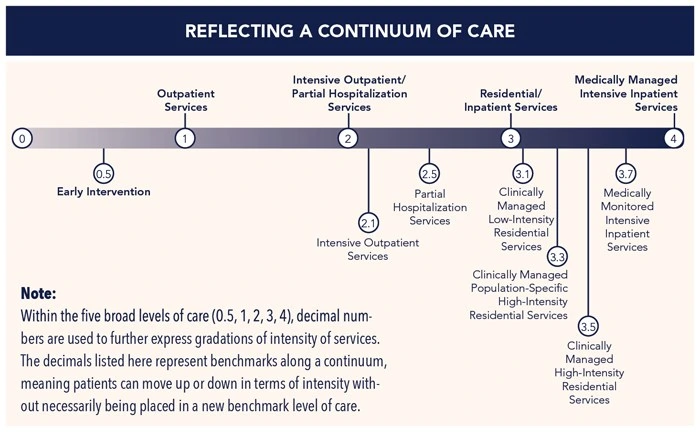
Then there's the assessment itself, which is what decides where on that continuum you land.
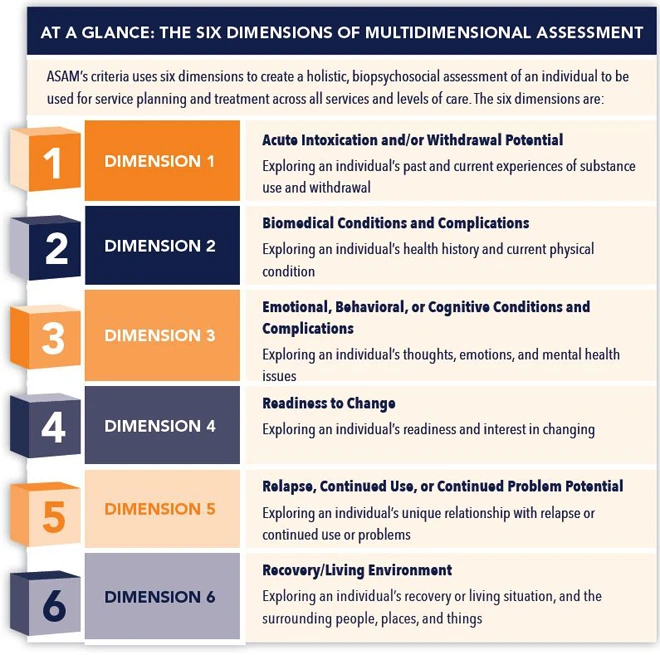
Those two pictures give you a far more detailed understanding of what I'm referring to than I could write out here. They come from ASAM's levels of care, which is what I was diligently trained on, alongside the DSM-5, the Diagnostic and Statistical Manual, which we won't get into today.
If you want more detail, go to asam.org. Then ask any program you're considering exactly where they operate on that continuum, and what each level actually involves in their building.
I understand this can feel overwhelming, especially by this point in what I'm sharing with you. That's part of why professionals exist. There are good therapists who keep resources for trusted programs. There are good interventionists who keep lists of ones they've vetted. And there are sober companions, counselors and coaches who do the same (in theory, and hopefully in practice). If I can be of service, that's what I specialize in, and it's a huge reason why I'm writing this. But I'll leave that entirely up to you. At this point I'm here to hand you the information and let you do with it what you will.
Where treatment actually loses people
Here's the part I saw from the inside, over and over.
Residential treatment is very good at one thing: interrupting a pattern in a controlled environment. Take away the access, add structure, add clinical support, and most people stabilize. That's real and it saves lives.
The trouble is that stabilizing in a building tells you very little about how someone does outside one. Thirty days of no access is not thirty days of practicing sobriety in your actual life, with your actual job, your actual marriage, and the bar you walk past every single day on your way home.
So people graduate, feel genuinely different, go home, and hit the exact set of triggers the building was designed to keep out. And they have to do it now without the schedule, the group, and the twenty other people who understood, which is rarely what anyone was prepared for.
That gap is where relapse lives, and it's a transfer problem rather than a character one.
This is what we often call "spin dry" in the industry. Someone comes into treatment, dries out from alcohol or whatever else in a fast ten to thirty day program, and then goes back out. It frequently ends in relapse. They did get a stretch of dry time out of it, which has real value, and dry time on its own was never the thing that keeps anybody sober.
This is also where the honest argument for continued treatment sits: in that transition. Whether that means more treatment, or stepping down through some continuing level of care, something in that gap is almost always going to be the therapeutic recommendation. That part the industry gets right.
The thing about ninety days
You'll hear that longer stays produce better outcomes, and the data does point that way. I want to offer a different reading of why.
The more consecutive days you put between yourself and a drink, the more confidence you build. That's the engine. Someone at day sixty genuinely believes they can do day sixty-one in a way that someone at day four does not, and that belief is doing enormous work.
Which means the mechanism isn't the building. It's the accumulation. And accumulation happens outside a facility too.
So yes, ninety days beats thirty. But it does not follow that you need a ninety day program, or a six month one, or a year, or that you should bleed your assets and refinance your house to buy one. What you need is a way to keep stringing days together with enough support that they hold. For some people that's residential. For plenty of others it isn't.
In fact it's worth holding some of your resources back for the back end, for exactly this reason. Front-load everything, burn through what you have, and you can find yourself in real trouble at the point you most need options.
If someone genuinely wants to get sober, there's a strong argument for starting at a lower level of care. That also happens to be what insurance providers typically ask to see attempted first, where it's clinically appropriate to try.
The reasoning is simple enough. People get sober in the rooms of AA. People get sober working with a therapist. People get sober working with a sober coach. People get sober by starting an entirely different kind of health programming that has nothing to do with sobriety and everything to do with changing how they live.
It's about pattern interrupt. How someone does that is largely up to them, their family, and the resources they actually have.
When a sober companion makes more sense
Working with a companion means the work happens in your life rather than away from it. That changes what's possible.
It tends to be the better fit when:
There's no physical dependence. If detox isn't a medical question, the case for a building gets much weaker.
You want genuinely one-to-one support. No treatment program can honestly promise you that, because it isn't how they're built. Facilities are designed to run peer-to-peer, with clinical and medical oversight sitting on top of it. That's the model. It has real value, and it is a different thing from individualized care. If a program tells you otherwise, either they're selling you something or they don't understand their own structure. When you want actual one-to-one, a sober companion gives you that in a way a facility never will.
The person can't disappear for a month. A surgeon, a founder, a parent of young kids. "Take thirty days off" is sometimes just a way of saying no.
The triggers are situational and specific. A tour, a wedding, a work trip, a divorce, a first holiday sober. You want somebody there in the moment, not a curriculum about the moment.
They've already done treatment. This is where the industry framing is right. The transition home is genuinely the highest-risk window and it's the one everybody under-resources.
Privacy is a real constraint. Some people will not walk into a facility under any circumstances, and a purist would rather they get nothing. I'd rather they get something that works.
I've written more on what the work actually looks like day to day, and on how a companion differs from a coach and a sponsor, since people use those three words interchangeably and they are not the same job.

The honest thing about money
A month of residential care commonly runs into the tens of thousands. My companion work runs $1,000 to $1,500 a day, and the market spans roughly $800 to $4,000. I publish that openly and I break down exactly what you're paying for.
Do the arithmetic and neither option is obviously cheaper. Two solid weeks with a companion can cost what a month inside costs. So price is a bad way to decide this, and I'd be suspicious of anyone leading with it, in either direction.
There's also insurance, and it cuts against me here. Insurance will not cover sober companionship. Plenty of plans will cover a program, including a hospital. So depending on your copay, you may genuinely find yourself in a better position going to treatment than trying to fund companion work out of pocket. That's worth knowing before you rule anything in or out.
Decide on fit and on medical need. Then look at cost.
If you're still with me this far, well done. That was a lot to take in, and I know it can feel like a great deal at once. There is help available, in more forms than most people know about. The fact that you've read this far also says something worth naming: you genuinely love whoever this is about, and that counts for a lot.
I'm a professional in this industry and I do offer paid services, so I don't want any of this to sound like I'm bashing paid work, or like I'm against one category or another. They all serve a purpose.
If you decide a sober companion is the right fit, good. If a coach makes more sense, good. Here is what mine costs, spelled out plainly so there's no confusion if you or someone you love ever wants to work with me. Coaching runs on tiers: $1,500 a month, or a 90-day container at $5,000 with daily access and more one-to-one time. Companion work is the day rate above.
I'm not here to sell you my services. If I were, I'd be in the same category as the admissions teams, just with better copy.
Plenty of people get and stay sober through AA, which costs nothing at all. Some people need far more than that, and there's no shame in either. Others do well with outpatient, or with therapy, or with an interventionist first. The right answer depends on the person in front of you, and anyone who gives you a confident recommendation before asking you anything is selling.
The question I actually ask families
When someone calls me about a person they love, I don't start with which service to buy. I start here:
What specifically are you afraid will happen in the next seven days?
The answer tells you almost everything. If it's he'll have a seizure or she'll hurt herself, you need a facility and you need it today. If it's he'll get through the wedding and then it'll all start again, that's a different problem with a different shape, and thirty days in a building may not touch it.
Most people never get asked that question, because most people ask the internet first, and the internet is being paid to answer.
So here's what I'd leave you with.
If the building took the substance away tomorrow, what would still be waiting for you when you walked back out?
Whatever comes up, that's the actual work. Where you do it matters far less than whether anyone helps you do it at all.

Not sure which one you need?
I'm happy to talk it through with you and tell you honestly if I'm not the right fit. I've sat on both sides of this, and I'd rather point you somewhere good than sell you something that doesn't work.
Email me directly about 1:1 Clinical Coaching, or start the conversation here. You can also learn more at Nomadic Addictt and read more about the inner work at Love Unlocked.